Go to the page content
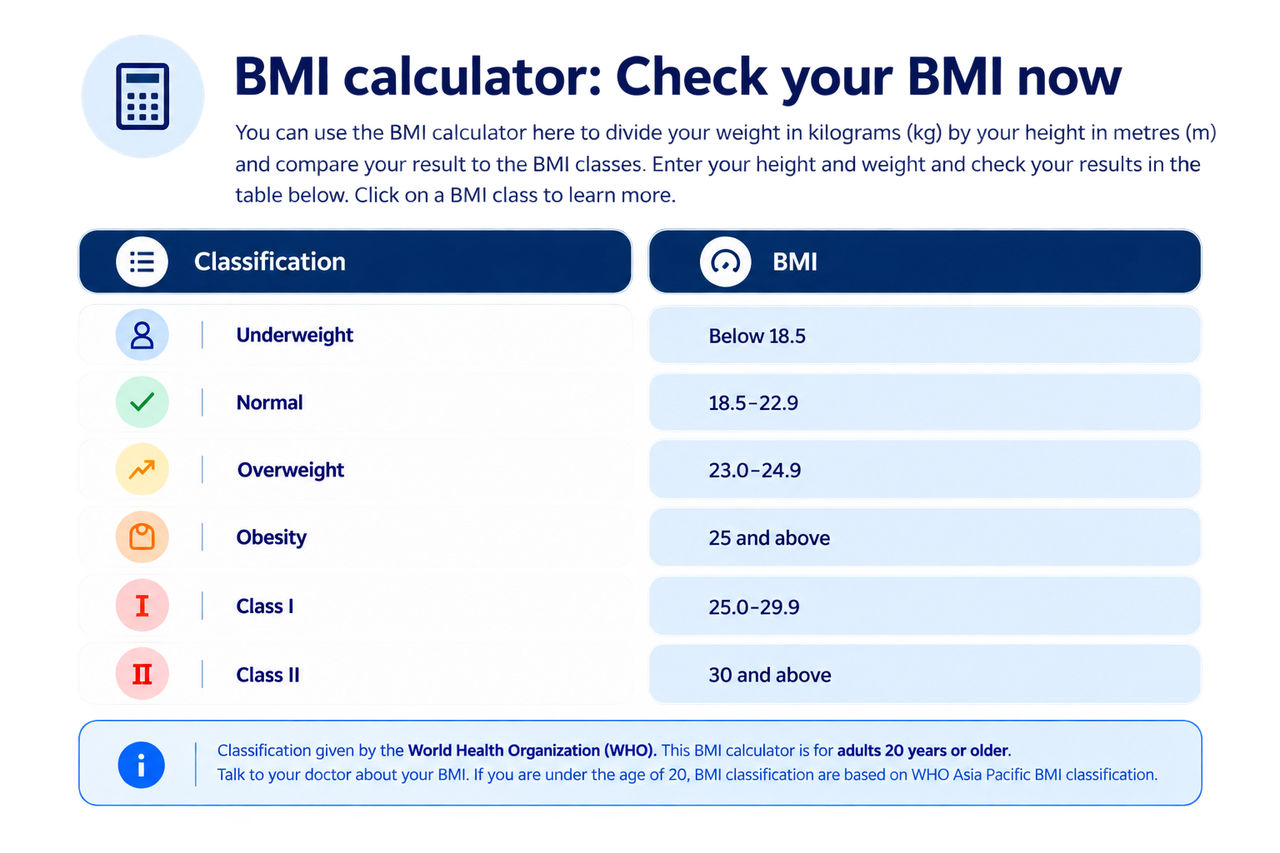
Obesity Class I
BMI

Professional support can make a difference​

Your BMI is within the Obese I range. A healthcare professional can assess your overall health and help you explore personalised, evidence-based weight- management support.​

bmi-calci

Which consultation type is right for you?

Both options connect you with qualified obesity specialist. Choose what works best for you


In-person consultation

with a local specialist near you

  • Face to face interaction
  • Hands-on physical exam possible
  • Choose your specific doctor

In person consultation

Find a specialist near you

Prefer to see someone face to face? Search by your address or use your location to find an obesity specialist clinic near you across Singapore.

kpj healthcare

Meet a healthcare professional in person​

Get personalised support at a KPJ
Healthcare clinic near you.​


Online Consultation

Speak to a specialist online

Malaysia based providers offering online consultations for weight management.
Compare the options and choose the support that suits you.​

Tips and advice for you

Explore Practical guidance for healthier everyday habits.

Nutrition

There is no perfect diet for losing weight. But there are scientifically proven ways of eating that can help you manage weight and prevent the weight from coming back. Focus on managing a healthy weight instead of going to extremes in limiting how much you eat. Here are some examples of diets for obesity treatment:

  • Mediterranean diet
  • High fiber diet
  • Vegetarian diet

Learn more about starting healthier ways of eating and choosing foods for better weight control here


Mental Health

There are many reasons why we gain and lose weight and sometimes, they have to do with how we feel.

Some people use food to cope with difficult situations and soothe their feelings. Eating to feel better is called emotional eating - and it's the reason why we sometimes need psychological support instead of diet advice.

Stress can also change the way that you eat and put you at more risk of developing obesity. Learning to manage the stress in your life is one strategy you can also include in your weight management plan. Get 8 tips for managing your stress and your weight.


Activity

Regular exercise is very important for losing and managing your weight. To make sure that your weight management programme is as effective as possible, consider adding aerobic and resistance exercises to your routine.16 You should also move more in general.

Find tips for getting a good start on a new exercise programme here.


Sleep

Getting too little sleep can affect your hormones, which can then affect how and what you eat. When you sleep better, you're better able to make healthy choices and resist tempting foods. Try these tips to improve your sleeping habits:

  • Create healthy routines around sleeping.
  • Relax before going to bed
  • Make your bedroom a great place to sleep

Learn more about getting the sleep your body and mind need here.


References
  1. Adult BMI categories (204) Centers for Disease Control and Prevention. Available at: https://www.cdc.gov/bmi/adult-calculator/bmi-categories.html#:~:text=BMI%20is%20a%20calculated%20measure,BMI%20is%20a%20screening%20measure.
  2. Sharon, A. (2024) 11 signs that you’re not eating enough, Healthline. Available at: https://www.healthline.com/nutrition/signs-of-not-eating-enough#skin-problems
  3. Rueda-Clausen, C F et al, “Assessment of People Living with Obesity,” Can. Adult Obes. Clin. Pract. Guidel., pp. 1–17, 2020.Available: http://obesitycanada.ca/wp-content/uploads/2020/09/6-Obesity-Assessment-v5-with-links.pdf.
  4. Durrer Schutz, D. et al. (2019) ‘European practical and patient-centred guidelines for adult obesity management in Primary Care’, Obesity Facts, 12(1), pp. 40–66. doi:10.1159/000496183.
  5. Garvey, W T et al, “American Association of Clinical Endocrinologists and American College of Endocrinology comprehensive clinical practice guidelines for medical care of patients with obesity.” Endocrine Practice 2016;22:1–203. DOI: https://doi.org/10.4158/EP161365.GL
  6. Prevention -Coronary heart disease (2024) NHS choices. Available at: https://www.nhs.uk/conditions/coronary-heart-disease/prevention/
  7. Liu, Leiling et al. (2025) Safety and effects of anti-obesity medications on weight loss, cardiometabolic, and psychological outcomes in people living with overweight or obesity: a systematic review and meta-analysis. DOI: https://doi.org/10.1016/j.eclinm.2024.103020
  8. Health risks of Overweight & obesity (2023) National Institute of Diabetes and Digestive and Kidney Diseases. Available at: https://www.niddk.nih.gov/health-information/weight-management/adult-overweight-obesity/health-risks
  9. Kirk SFL, Ramos Salas X, Alberga AS, Russell-Mayhew S. Canadian Adult Obesity Clinical Practice Guidelines: Reducing Weight Bias in Obesity Management, Practice and Policy. Available from: https://obesitycanada.ca/guidelines/weightbias
  10. Factors affecting weight & health - NIDDK (2023) National Institute of Diabetes and Digestive and Kidney Diseases. Available at: https://www.niddk.nih.gov/health-information/weight-management/adult-overweight-obesity/factors-affecting-weight-health
  11. Estruch R & Ros E. The role of the Mediterranean diet on weight loss and obesity-related diseases. Reviews in Endocrine and Metabolic Disorders 2020; 21:315–327.
  12. Sanders LM et al. Effects of Whole Grain Intake, Compared with Refined Grain, on Appetite and Energy Intake: A Systematic Review and Meta-Analysis. Advances in Nutrition 2021; 30;12(4):1177-1195.
  13. Xu, Y. et al. (2024) ‘Relationship of vegetarianism with body weight loss and ASCVD’, Frontiers in Nutrition, 11. doi:10.3389/fnut.2024.1419743.
  14. Mayo Clinic. Weight loss: Gain control of emotional eating. Available at: https://www.mayoclinic.org/healthy-lifestyle/weight-loss/basics/weightloss-basics/hlv-20049483
  15. van der Valk ES, Savas M, van Rossum EFC. Stress and Obesity: Are There More Susceptible Individuals? Curr Obes Rep. 2018 Jun;7(2):193-203. doi: 10.1007/s13679-018-0306-y
  16. Calculating your calories burned (2024) Mayo Clinic. Available at: https://www.mayoclinic.org/healthy-lifestyle/weight-loss/in-depth/exercise/art-20050999
  17. Ong J, Chirinos D & Yap B. Relationship Between Sleep Health and Your Weighthttps://www.obesityaction.org/community/article-library/the-relationship-between-sleep-health-and-your-weight/
  18. NHS. How to get good sleep: Sleep and Tiredness: https://www.nhs.uk/live-well/sleep-and-tiredness/how-to-get-to-sleep/
  19. Powell-Wiley, T.M. et al. (2021) ‘Obesity and cardiovascular disease: A scientific statement from the American Heart Association’, Circulation, 143(21). doi:10.1161/cir.0000000000000973.
  20. van Walree, E.S. et al. (2022) ‘Disentangling genetic risks for metabolic syndrome’, Diabetes, 71(11), pp. 2447–2457. doi:10.2337/db22-0478.
  21. Canada, P.H.A. of (2024) Government of Canada, Canada.ca. Available at: https://www.canada.ca/en/public-health/services/chronic-diseases/chronic-disease-risk-factors.html (Accessed: 28 May 2025).
  22. Eating & physical activity to lose or maintain weight - NIDDK (2023) National Institute of Diabetes and Digestive and Kidney Diseases. Available at: https://www.niddk.nih.gov/health-information/weight-management/adult-overweight-obesity/eating-physical-activity.
  23. Ashwell, Margaret. (2011). Charts Based on Body Mass Index and Waist-to-Height Ratio to Assess the Health Risks of Obesity: A Review. The Open Obesity Journal. 311. 78-84. 10.2174/1876823701103010078.
MY26OB00099